
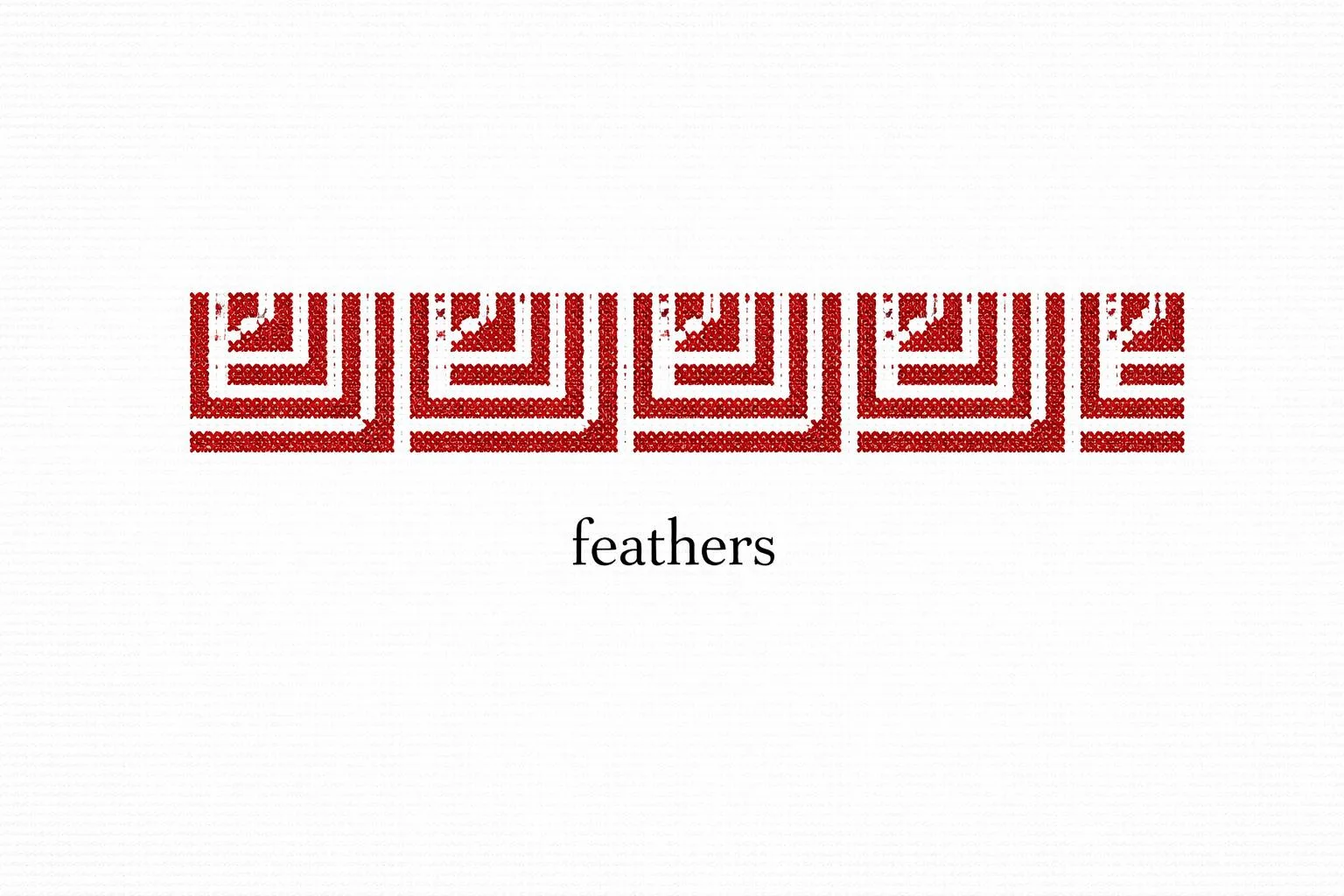
The Feathers Motif is one of the nature-inspired forms in Palestinian Tatreez. Unlike many geometric motifs, it evokes movement and lightness through thin repeated lines. Moreover, the motif reflects how Palestinian embroidery could translate natural forms into structured stitched rhythms.
Meaning of the Feathers Motif
In traditional textile symbolism across the Levant, feather-like forms were often associated with air, freedom, and movement. When translated into embroidery, the motif introduced a visual rhythm that felt lighter than dense motifs such as diamonds or stars.
Because of this quality, feather-like patterns were sometimes used in areas of the dress where embroiderers wanted to create flow and direction in the design, guiding the eye across the embroidered panel rather than fixing it around a central shape.
Visual Function in the Thobe
In many embroidered compositions, the Feathers Motif works as a transitional pattern. Instead of acting as the main focal element, it helps connect other motifs together.
Its elongated structure makes it particularly suitable for borders, vertical bands, or repeating decorative strips. This structural role is important in Palestinian embroidery, where the layout of the dress often relies on carefully balanced bands of patterns running across the chest panel or sleeves. To place this motif within the wider history of dress traditions, readers can explore Palestinian thobes by region and compare how motifs and embroidery layouts developed across Palestine.


Cultural Context
The appearance of feather-like motifs reflects a broader tendency in Palestinian embroidery to draw inspiration from elements of the natural environment. While the designs become highly geometric through the cross-stitch technique, their names and visual references often remain tied to recognizable forms such as plants, birds, or stars.
Therefore, the Feathers Motif shows how traditional Palestinian Tatreez could combine geometry, motion, and natural reference within one embroidered composition.
Explore the Map of Traditional Palestinian Thobes
See where each Palestinian thobe originates across the regions of Palestine.
Open the MapSources
UNESCO — Art of Embroidery in Palestine
PalQuest — Palestinian Embroidery
Shelagh Weir — Palestinian Costume (British Museum Publications)