

Floral Symbolism
Moreover, floral imagery has long been part of decorative traditions in the eastern Mediterranean, often symbolizing beauty, renewal, and life.
In addition, the Damask rose (Rosa damascena) has been cultivated in the region for centuries for perfume, medicine, and ceremonial uses. Because of this cultural importance, stylized rose imagery became part of regional decorative arts, including Palestinian embroidery. To see how floral and regional motifs appear across traditional dress, readers can explore Palestinian thobes by region and discover how embroidery traditions developed across Bethlehem, Hebron, Ramallah, Gaza, and other regions of Palestine.
Geometric Translation in Tatreez
However, although Tatreez is created through geometric cross-stitch techniques, motifs like the Rose of Damascus show how natural forms were translated into structured embroidery patterns that combine botanical inspiration with geometric textile design.
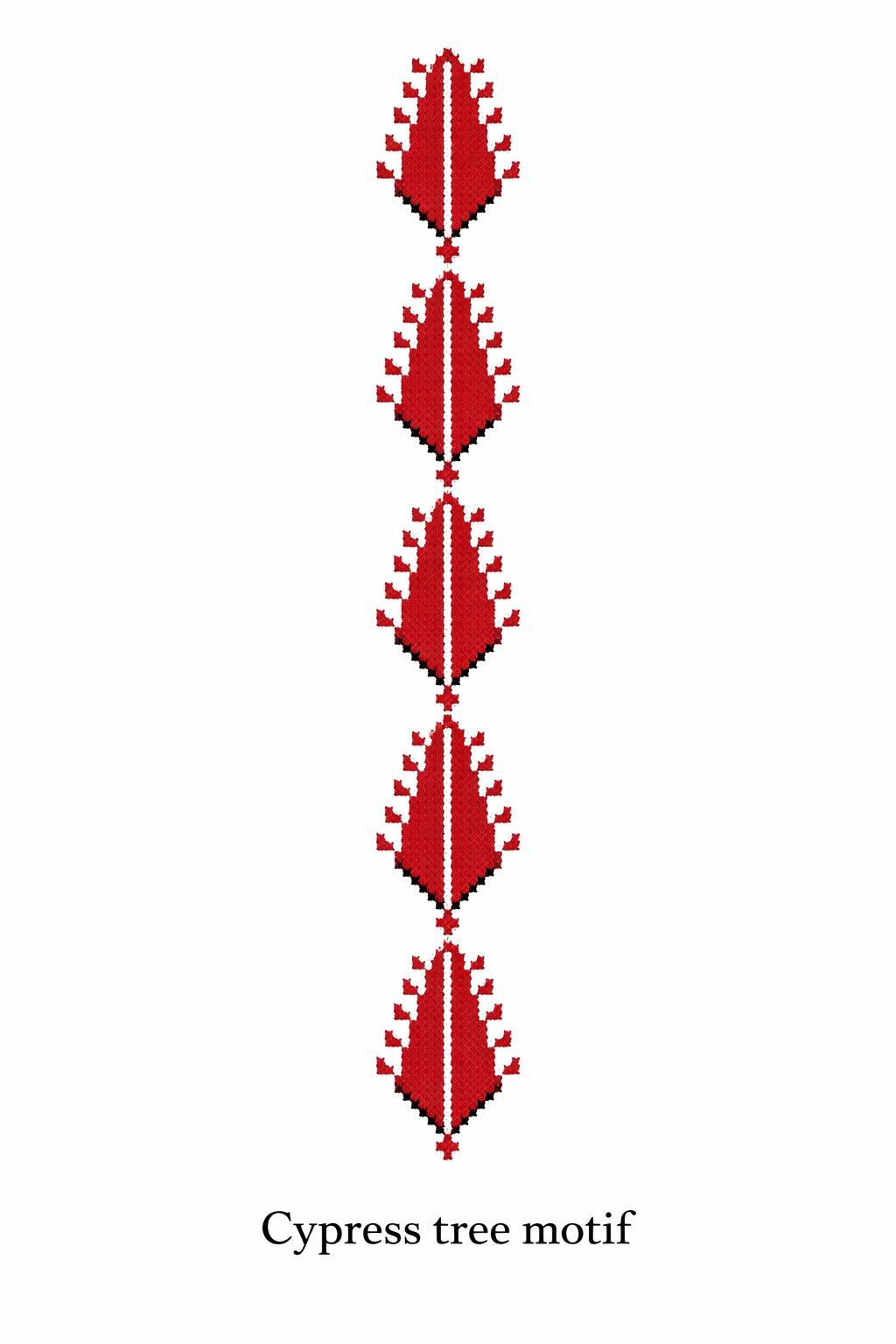
Therefore, traditional Palestinian embroidery relies on the counted cross-stitch technique which follows the grid structure of woven fabric and produces symmetrical geometric forms. For this reason, flowers are translated into stylized patterns, with petals simplified into balanced embroidered shapes that fit the structured rhythm of Tatreez stitching.


Regional Context
Floral motifs similar to the Rose of Damascus appear in embroidery traditions of central Palestinian regions, especially Bethlehem, Hebron, and Ramallah.
These regions became known for richly embroidered dresses where floral and geometric motifs were combined across the embroidered panels of the Palestinian thobe.
See the map of Palestinian thobes by region
See where each Palestinian thobe originates across the regions of Palestine.
Open the Map