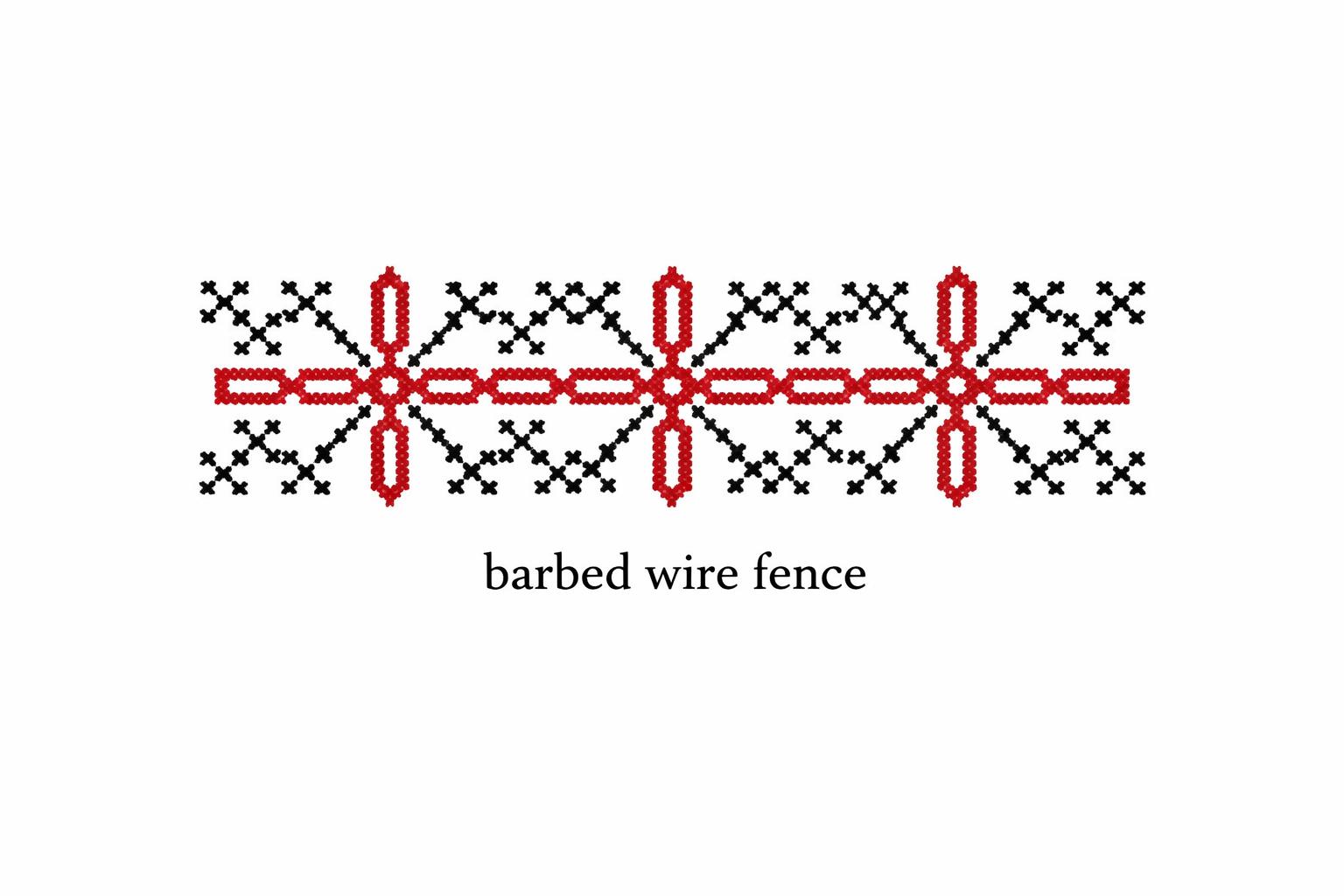
The Barbed Wire motif is one of the most recognizable contemporary symbols used in modern interpretations of Palestinian Tatreez embroidery. Unlike older Palestinian embroidery motifs that often draw from flowers, trees, crops, and geometric forms, this motif reflects more recent historical experience. In contemporary Palestinian textile art, the Barbed Wire motif expresses memory, restriction, endurance, and the ability of embroidery to respond to changing realities while remaining rooted in cultural heritage.


Symbolism of the Barbed Wire Motif in Palestinian Embroidery
The Barbed Wire motif in Palestinian embroidery marks a shift toward political and social symbolism within Tatreez. In modern embroidery and textile design, barbed wire can symbolize restriction, separation, displacement, and the difficult realities of borders and confinement.
At the same time, the motif also carries meanings of resilience, resistance, and steadfastness. Therefore, its presence in contemporary Tatreez shows that Palestinian embroidery is not only a historical craft. It is also a living cultural form that absorbs new meanings while preserving older methods.
Geometric Form and Contemporary Visual Language
In stitched form, the Barbed Wire motif appears as repeating angular lines. These lines echo the rhythm of barbed wire.
However, this balance between old technique and new symbolism is one of the most important features of modern Tatreez practice. It demonstrates that Palestinian embroidery can evolve without losing its cultural foundations, adapting inherited forms to express modern memory and historical experience.
Palestinian Embroidery as Cultural Record
Today, motifs such as barbed wire are increasingly used by artists, designers, and cultural projects that connect historical embroidery traditions with contemporary Palestinian narratives. In this sense, Tatreez continues to function as more than decorative craft. It acts as a visual record of identity, collective memory, and cultural survival.
The Barbed Wire motif in Palestinian Tatreez therefore represents more than a pattern. It shows how embroidery can preserve heritage while also documenting the changing realities of Palestinian life through thread, structure, and symbol.
See the map of Palestinian thobes by region
Explore where each Palestinian thobe originates and discover how embroidery traditions vary across the regions of Palestine.
Open the Map